
Economy
Everything you carry can be traded: on the market while you sleep, or hand to hand with the hero beside you. And the gold you earn is meant to stay worth earning.
The market
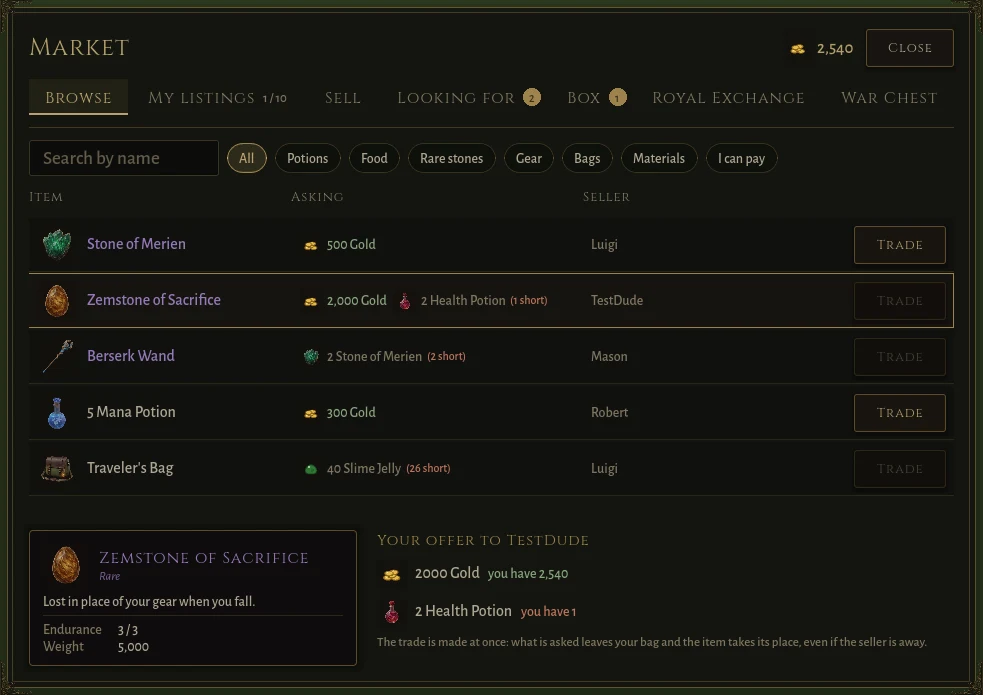
Press F10, or the scales on your bar, and the market opens like a ledger. List something from your bag for gold, for goods, or for both, asking for as many kinds of item as you like.
The market holds what you list, so every offer can always be honoured. Anyone with what you ask presses Trade and the swap is made at once, whether you are online or not. Your payment goes straight to your bag if you are about and have room, or waits in your market box until you collect it. You may keep up to 10 listings up at a time and call any of them back. Listing costs a small deposit in gold, and the market keeps 5% of gold received; more on why below.
Browse and sell
Browse searches by name, filters by kind (potions, food, rare stones, gear, bags, materials) and, with I can pay, shows only what you can afford right now. Each price is a row of chips; the ones you are short of say by how much.
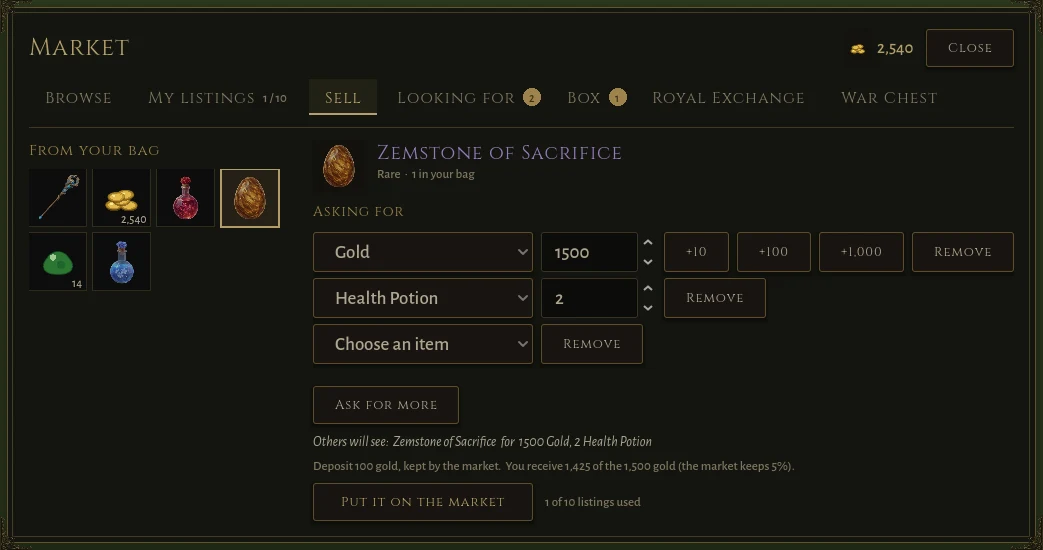
Sell starts from your bag laid out as a grid. Pick an item, set the price with quick gold steps or any amount you like, add goods if you want them, and see exactly what others will see before you put it up.
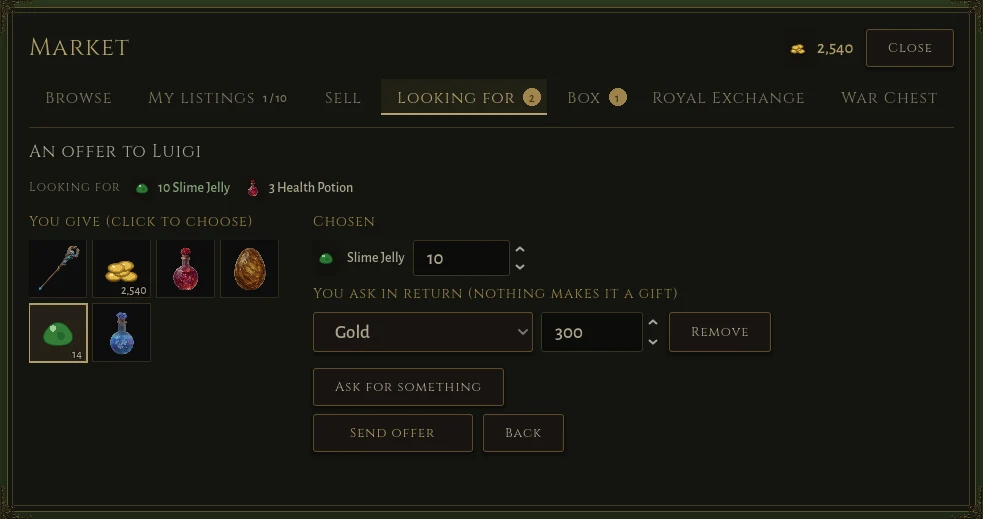
Looking For
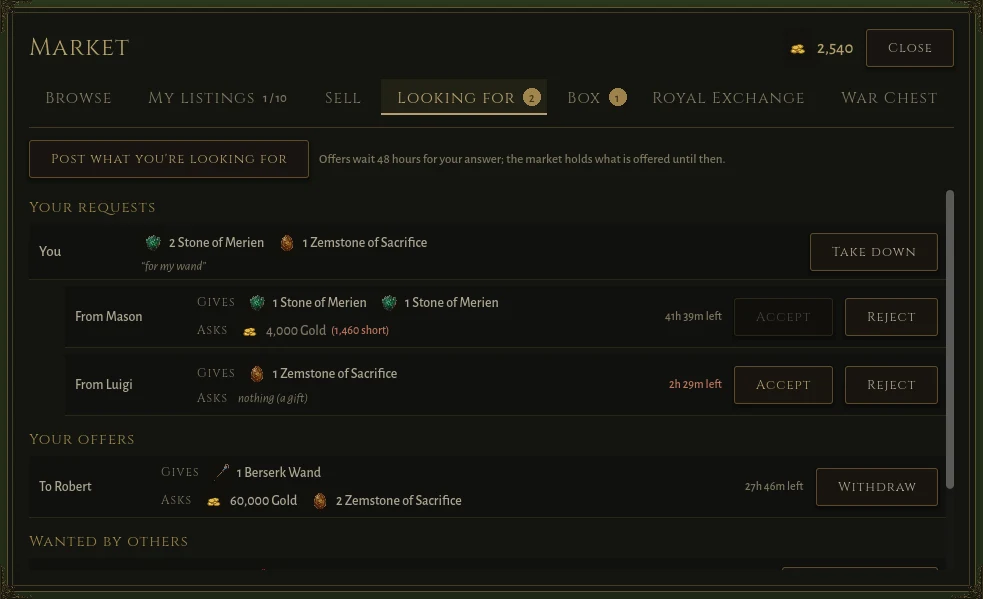
Cannot find it on the market? Say what you are after: any items, any amounts, and a note if you like.
Anyone can answer with an offer from their bag, asking for anything in return or for nothing at all. The market holds what they offer, so it is there when you say yes. You have 48 hours to accept, and the swap happens at once, or to reject; rejected, withdrawn and lapsed offers go back to whoever made them. There is no limit on how many requests you post or how many offers you make.
The merchant and the smith
Click a general store, a market stall or a smithy and your hero walks to its door; the window opens once you are within 4 tiles.
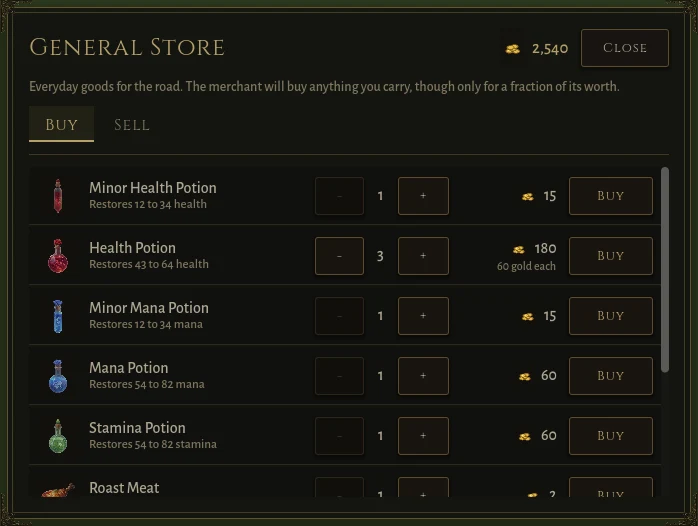
The merchant
Everyday goods for the road, at their worth: Minor Health Potion (15 gold), Health Potion (60 gold), Minor Mana Potion (15 gold), Mana Potion (60 gold), Minor Stamina Potion (15 gold), Stamina Potion (60 gold), Roast Meat (2 gold), Baguette (2 gold), Small Pouch (100 gold), Traveler's Bag (400 gold). He will buy anything you carry except gold, but only for 15% of its worth, times how whole it is; a broken item counts as a tenth.
Wear and the smith
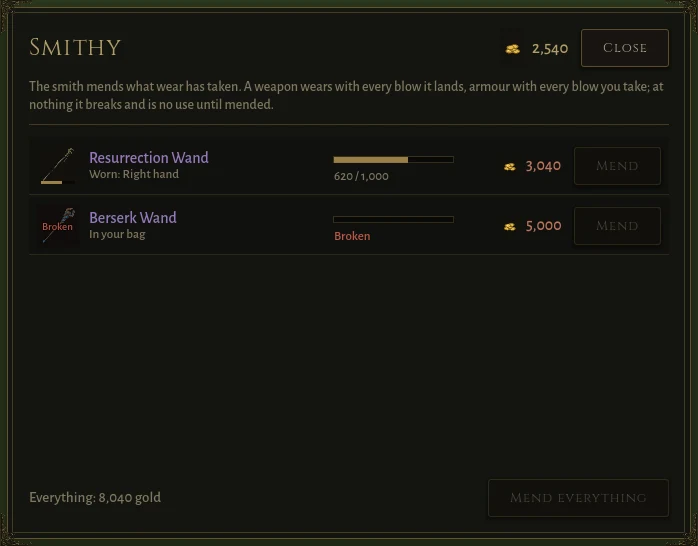
Gear wears as it did in the original, which calls it endurance. A weapon loses a point with every blow it lands; a piece of armour, chosen at random, loses a point with every blow you take. The wands last 1,000 blows. With a tenth left you are warned; at nothing the piece breaks, comes off, and cannot be worn until it is mended.
The smith mends it for 10% of its worth times the part that was lost, and Mend everything sees to the lot at once.
Trading between heroes
Right click a hero within reach and choose Trade or Give.
Trade
Both of you put items up, both of you accept, and the swap happens all at once or not at all. Change anything and both accepts clear, so nobody is caught out by a last-second switch. Walk apart, fall, or leave the world and the trade simply ends.
Give
Hands a stack straight over, if the other hero has the room and the strength to carry it.
Gold that stays gold
Every Helbreath world we remember ended the same way: gold became worthless. Monsters printed it without end, very little ever destroyed it, and nothing worth having could be bought only with gold. So prices climbed, and real trade moved to Zemstones and rare stones instead.
Economists call the two sides of this faucets (where money comes from) and sinks (where it goes). A healthy world needs both in balance, and it needs to see what is happening. Our answer comes in six parts, in this order. The first three are in the game today; the rest follow as the systems they need are built.
The Royal Treasury
In the game nowThe Treasury counts every coin the world makes and every coin it destroys, by source and by day, so it always knows how much gold exists and where it lies: in bags, on the market, in market boxes, on the ground. It keeps a price index from gold sales on the market, following a basket of everyday goods (Health Potion, Mana Potion, Stamina Potion, Slime Jelly, Zemstone of Sacrifice, Stone of Xelima, Stone of Merien).
Gold drops belong to the game, not to anyone's whim: each monster carries its own gold, scaled by the Treasury (today at 1.0 times its own). Every hero gets a generous daily share of 5,000 gold from monsters; past it, monster gold falls to a quarter for the rest of the day, which leaves ordinary play untouched and takes the profit out of bots and endless farming. World bosses are exempt.
The market levy and listing deposits
In the game nowPutting an item on the market costs a deposit in gold of 1% of its worth (at least 5 gold), even when you ask for goods rather than gold, and the market keeps 5% of any gold a seller receives. Both are destroyed, not paid to anyone, so every busy market day takes a little gold out of the world. The Sell tab shows the deposit and exactly what you will receive before you list.
Merchants and repairs
In the game nowThe merchant sells everyday goods at their worth, and that gold is destroyed. He buys anything but gold for 15% of its worth, less for worn gear. That gold is new, but he pays little enough that selling loot never makes gold faster than hunting does.
Gear wears and the smith mends it for up to 10% of its worth, in proportion to the wear; that gold is destroyed too. Gold spent this way is gone, which is exactly what keeps the rest of it worth something.
The War Chest
Coming nextHeroes of Aresden and Elvine pour gold into their nation's chest to raise blessings for the whole nation and to build engines of war, with a roll of honour for its patrons. The richest heroes get something worth buying, and the gold leaves circulation.
The Royal Exchange
ComingA small daily stock of Zemstones, Xelima and Merien, sold only for gold. Once the rarest stones have a price in gold, gold is how they are priced everywhere, and nobody needs to barter in stones instead.
The stabiliser
ComingEach week the Treasury reads the price index and gently adjusts the levy, monster gold and the Exchange to keep prices steady, and the changes are announced in the world. Small, regular, public steps, never surprises.